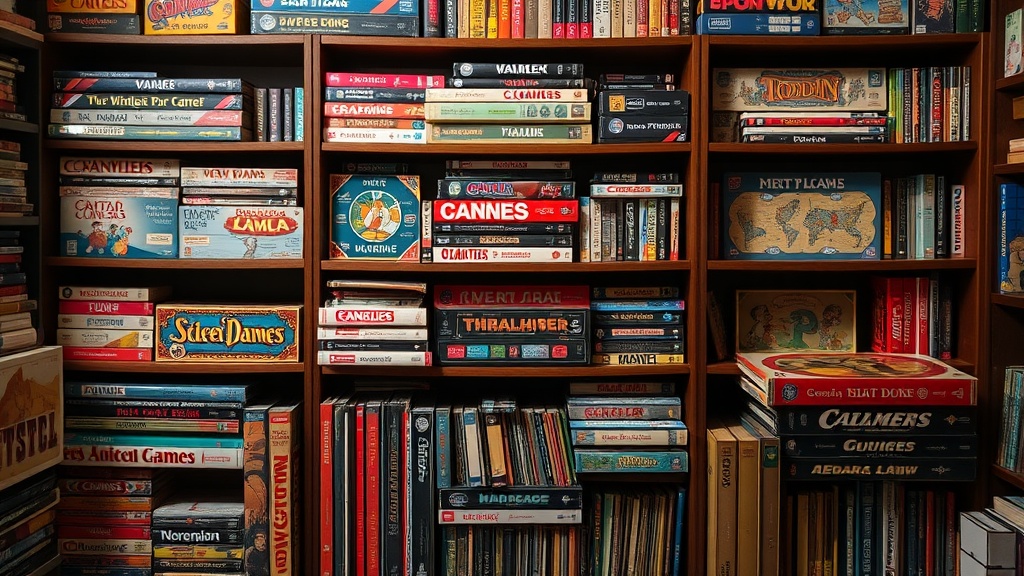
How to Properly Store and Display Your Vintage Board Game Collection

What's the Best Way to Store Vintage Board Games Without Damaging Them?
The best way to store vintage board games is upright on shelves (like books), in a climate-controlled environment away from direct sunlight, with humidity between 45-55%. This post covers everything needed to protect and showcase a collection—from proper shelving techniques and climate control to display methods that won't cause warping or fading. Whether the collection includes a 1935 Monopoly set or a pristine 1979 D&D Basic Box, the right approach means the difference between appreciating in value and becoming a pile of warped cardboard and faded ink.
Why Do Vintage Board Games Deteriorate So Quickly?
Board games deteriorate through a combination of light exposure, humidity fluctuations, improper stacking, and acidic storage materials. The cardboard used in mid-20th century games was manufactured with high wood pulp content, making it particularly susceptible to acid migration and warping. Older games used glue that becomes brittle, and the inks of the era often weren't lightfast.
The biggest threat? People treating vintage games like they're indestructible. That 1960s copy of Risk has survived six decades—it deserves better than a garage shelf. Here's what actually causes the damage:
- UV light — fades box art and board colors within months of direct exposure
- Humidity swings — above 60% encourages mold; below 30% dries out cardboard and glue
- Stacking boxes horizontally — bottom boxes crush under weight; boards warp
- Acidic materials — standard cardboard, newsprint, and some plastics release acids that yellow components
- Pest exposure — silverfish love old paper, and cardboard edges attract rodents
Fredericton's climate—cold winters, humid summers—creates exactly the kind of fluctuation that destroys collections. Local collectors have learned the hard way that attics and basements here are game graveyards.
How Should You Store Board Game Boxes to Prevent Damage?
Store board game boxes vertically on sturdy shelving, spine-out, with enough space to slide them out without catching edges. Never stack boxes more than three high—and even that's pushing it for heavier titles. The pressure from above compresses corners, creates creases, and eventually splits seams.
For shelving, skip the particleboard units from big-box stores. They sag. They off-gas formaldehyde. They're terrible. Instead, consider:
| Storage Solution | Best For | Approximate Cost | Key Consideration |
|---|---|---|---|
| IKEA KALLAX (5x5) | Medium collections, mixed box sizes | $199 CAD | Vertical slots prevent stacking; 13" depth fits most vintage boxes |
| Sturdy shelving with 14" depth | Larger titles (Avalon Hill war games, 3M bookshelf games) | $150-300 | Metal frames with real wood shelves; avoid particleboard |
| Banker's boxes with lids | Overflow, less valuable titles | $25-40 per 10-pack | Must be acid-free; Archival Methods brand recommended |
| Flat files (map cabinets) | Boards, punchboards, flat components | $400-800 used | Excellent for preserving flat boards; check used office supply stores |
That KALLAX unit? It's become the unofficial standard in collector circles. The cube dimensions—13" x 13" x 15"—fit most Parker Brothers, Milton Bradley, and early Avalon Hill boxes perfectly. The vertical orientation means no crushing, and the open front allows air circulation.
What Climate Conditions Protect Vintage Games Long-Term?
Vintage board games need stable temperatures between 65-72°F (18-22°C) and relative humidity between 45-55%. More important than hitting exact numbers is stability—swings of 20 degrees or 30% humidity do more damage than slightly suboptimal steady conditions.
The Northeast Document Conservation Center recommends these parameters for paper-based collections, and board games are essentially paper products with extras. Here's how to achieve them without building a museum-grade vault:
Practical Climate Control
A basic Frigidaire dehumidifier (30-50 pint capacity) handles summer humidity in most spaces. In winter, when forced-air heating drops humidity below 30%, a simple evaporative humidifier—Honeywell makes reliable units—brings levels back up. The key is monitoring. You can't manage what you don't measure.
Get a SensorPush or Govee Hygrometer. They're $25-40, connect to phones, and log data over time. One collector in Oromocto discovered his "climate-controlled" game room was swinging from 35% to 70% humidity seasonally—explaining why his Squad Leader boards had started warping.
Keep games away from exterior walls (temperature fluctuations) and vents (direct hot/cold air). Interior walls, mid-height on shelving, provide the most stable environment in a typical home.
How Can You Display Vintage Games Without Causing Damage?
Display games behind UV-filtering glass or acrylic, positioned away from direct sunlight, with LED lighting only. The goal is visibility without exposure—treat displayed pieces like museum artifacts because, essentially, they are.
Here's the thing about display: every moment a vintage game sits open on a coffee table, it's deteriorating. Light fades. Dust settles. Temperatures fluctuate. That said, games are meant to be appreciated. The solution is rotation and protection.
For active display, consider:
- IKEA DETOLF cabinets — glass-fronted, affordable ($90), and with a simple LED strip upgrade, they become reasonable display cases
- Custom acrylic cases — for truly valuable pieces ($200+ titles), companies like Wata Games (primarily video game graders) offer display solutions adaptable to board games
- Shadow boxes — for displaying single components (boards, unique pieces) while storing the box safely
If displaying the actual game isn't necessary, high-resolution photography achieves the same visual impact. Print a 20x30 poster of that pristine Fireball Island box art for $30—far cheaper than replacing a sun-faded original.
Handling and Play
When games do come off the shelf—for play, for photos, for showing friends—handle them properly. Clean hands (oils transfer), support the bottom (don't grab by edges), and never force stuck boxes. That "stuck" 1950s Monopoly box? The cardboard has swollen. Forcing it will split the corner. Gentle wiggling, perhaps a thin plastic blade run along the seam, preserves integrity.
During play, use playmats. The KMC Card Barrier series works well, or simply a clean tablecloth. Food and drinks stay in another room. Full stop. One spilled beer doesn't just stain—it invites mold, attracts pests, and destroys value permanently.
What Supplies Protect Game Components Inside the Box?
Component-level protection involves acid-free bagging, archival tissue, and proper piece storage. The original plastic bags in vintage games? They're often degrading, becoming sticky or yellowed. They need replacement.
For cards and punchboards, Polypropylene bags (not PVC—PVC off-gases and damages paper) from Archival Methods or Crystal Clear Bags from ClearBags provide protection without chemical interaction. Standard sandwich bags contain plasticizers that leach over time—avoid them.
Specific component recommendations:
- Paper money and documents — Archival Methods' acid-free document sleeves; store flat, never folded
- Wooden/plastic pieces — compartmentalized storage within the box; Plano tackle boxes (3700 series) fit inside many larger game boxes
- Card decks — penny sleeves for standard cards, Dragon Shield for valuable decks
- Punchboards — leave unpunched if preserving value; if punched, store counters in labeled baggies with archival tissue between layers
- Boards — store flat when possible; if folded, support the spine when opening to reduce stress on the hinge
Worth noting: some collectors use silica gel packets inside boxes. They're fine—but only with monitoring. Saturated silica gel releases moisture back into the environment. Rechargeable indicating desiccant (changes color when full) is safer.
When Should You Consider Professional Conservation?
Professional conservation becomes worth considering for games valued above $500 or with significant sentimental/historical importance. The CoolStuffInc network and specialized board game auction houses like Heritage Auctions can recommend conservators experienced with paper-based games.
The catch? Conservation isn't restoration. A conservator stabilizes condition—they don't make a game look new. Reproduction boxes, touched-up art, replaced components? That enters the realm of restoration, and in collecting circles, disclosed restoration affects value differently than undisclosed restoration. (Always disclose.)
For the typical collector with games in the $50-300 range, proper storage and handling provide all the protection needed. Professional intervention is overkill for a well-loved copy of Pay Day from 1974.
Building a Collection That Lasts
Start with the environment—stable temperature, controlled humidity, no direct light. Move to storage—vertical shelving, proper materials, no stacking. Then display—protected, rotated, appreciated without exposure.
The vintage games worth collecting have already survived decades. Some made it through attics, basements, garage sales, and childhood bedrooms. With proper care, they'll survive decades more—ready for the next player, the next collector, the next generation of enthusiasts who appreciate that cardboard and paper can hold something genuinely worth preserving.
Steps
- 1
Assess Your Collection and Storage Environment
- 2
Implement Climate Control and UV Protection
- 3
Choose Archival-Quality Storage Materials